The Permanent Underclass
There’s this phrase that’s taking root in our Silicon Valley discourse. It drives me nuts and I’m making a clarion call for us to push back against its toxic ideology.
It’s The Permanent Underclass.
I can’t say how widely the phrase has spread but in my corner of the world - Silicon Valley, Technology - it comes up often enough that I assume most of my peers have at least heard it even if they are not regularly discussing it.
The usage of this phrase is unevenly distributed. Some people are conversant in the topic, others are obsessed.
Demographically, my observation is that the more techy, the younger, and the more highly paid an individual is, the more deeply the idea of a looming permanent underclass is likely to have taken hold.
So: what is the permanent underclass?
At its core “the permanent underclass” is shorthand for the collision of three massive forces: (1) our capitalist system, (2) the persistent failures of our economic and political system over time, and (3) the trend of our contemporary progress in technology and AI followed to its conclusion without interruption.
Subscribing to a permanent underclass is to subscribe to a belief that machine intelligence and robotic capabilities are on the verge of crossing a critical threshold at which point mere humans will immediately and suddenly become comparatively incapable and, therefore, irrelevant.
In practice, I hear the permanent underclass used to refer to the vast majority of people who will not have amassed enough financial capital to be relevant once AI and robotics have made human effort economically worthless. It refers to the alleged vast majority of people who will be left behind.
The significance of the underclass is not primarily about their economic status, as the name might suggest. Instead the underclass matters because they will be forever robbed of agency in a post-AI economy.
In my opinion, an individual’s propensity to subscribe to the notion of an imminent permanent underclass can be attributed to a deep and terrible insecurity that they are themselves on the verge of becoming irrelevant.
I have argued against the notion of universal machine supremacy - and, conversely, the human irrelevance which accompanies it - in my past writings. I’m not going to relitigate whether machines will make humans economically irrelevant here.
Instead, I will talk about what the mythos of the permanent underclass has done to people.
An Inhumane Vision of the Future
Inextricably tied to the belief that a permanent human underclass looms around the corner is a desperate urgency to escape it. Indeed, the reason why its believers frame the situation in economic terms at all - rather than focusing on the skills and contributions of humanity relative to machines, which is the actual intellectual core of the argument - is because the underclass is being implicitly paired with its opposite, the permanent overclass, and the urgent need to belong to that overclass.
The logic goes that because individual human talent and capability will soon become irrelevant the only thing which will soon matter will be capital.
This results in an urgency for its proponents to accumulate and hoard personal financial capital - and immense quantities of it - such that their comparative advantage in society will be preserved in a future where their skills no longer matter.
Don’t bother pointing out to these people that the assumption that the rule of law and that property rights will be preserved in a world where humanity has become irrelevant is a strong one; nor bother questioning how social comparative advantage could mean anything when humanity has no productive value. Such nuance and second-order type thinking is often beside the point to them.
In some sense, the idea of accumulating reserves of financial capital for a well-defined vision is not new. We saw a version of this in the 2010s in the FIRE movement. For those unfamiliar, Financial Independence / Retire Early was a philosophy that gained traction following the Financial Crisis of 2008-2010. Individuals, often millennials, sought to accumulate sufficient capital rapidly enough that the passive income and drawdown from their nest egg would last the rest of their lives. The logic went that they could then retire young and escape the trappings of our capitalist socioeconomic system and live out the rest of their lives free.
FIRE wanted to escape the rat race and just be.
(A decade later, FIRE communities are more ambivalent and less ardent in spreading this gospel than they once were. It turns out that, for many FIRE individuals, financial independence optimized at the expense of other priorities did not produce personal fulfillment. Many chose to go back to work and participate in capitalism after all.)
But I argue that the escape the permanent underclass movement has a different tone from FIRE altogether. This one is a movement tinged not with hope and optimism, as FIRE was, and it doesn’t reject and try to resolve the faults of the socioeconomic capitalist status quo, as FIRE did.
Instead this movement embraces a system which it presumes is doomed and, rather than try to fix it, its acolytes seek to ossify themselves into the very few positions of forever privilege they believe remain open for the taking.
The movement doesn’t even attempt to pretend that inequality is somehow good, as trickle down economics and the Reaganism of the 1980s did. Rather its mantra is, in brief, no more complicated than: “the future is fucked and I need to get mine before it’s too late.”
Permanent underclass also differs from FIRE in the magnitude of its financial ambition.
Whereas FIRE - at least, as I heard it at the time - aspired to a modest life lived within simple communities that came with a modest cost of living, and required nothing more than the necessary yearly stipend to live an austere and sustainable life within those environs; somehow those who subscribe to a future permanent underclass seemingly will be satisfied with nothing less than two, or three, or more!, orders of magnitude more wealth than that. As if somehow anything less than hundreds of millions of dollars would be insufficient to ensure their basic survival and ongoing happiness in a machine supremacy society.
If I’m honest, it’s difficult for me to follow this train of thought with compassion and empathy.
I have increasingly, and independently of this conversation, come to believe that a darkness has been seeping into the Valley, and that this darkness is rotting both the Valley’s individual constituents and, ultimately, its ecosystem from the inside out. There is a cynicism which grows and festers here; a zero-sum manner of thinking; a mindset to take while the going is good rather than create in the belief that value will be rewarded.
I think my critique of those who adopt and preach a mindset of the permanent underclass comes down to the fact that it is, in my eyes, the culmination of a hypocritical mix of helplessness and nihilism and bold-faced greed. And, tragically, that moral contradiction is held within those I generally think are the brightest and most promising amongst us.
It’s a helplessness that the irrelevance of man lies just over the horizon and that any individual’s capacity to affect themselves or their environment is about to forever disappear.
It’s a nihilism that rather than resist, the rational thing to do is embrace this vision of the future and leave everyone else behind to catch the last few open lifeboats for themselves.
And it’s a greed that nothing less than deific levels of wealth will be satisfactory.
“Financially, what will take me to $1bn?”
It’s so fucking sad that the youngest and brightest and most promising among us have been brainwashed to think this way.
The Realities of the Present
The saddest part is that, in some sense, the permanent underclass does exist. It’s here. It’s been here for decades. It’s been here for the entirety of my lifetime, at least, but probably for much longer. It’s the socioeconomic backdrop and the privilege of birth we live with today.
There is a fiction we tell: the American Dream.
Rags to riches.
“Only here in America, anyone, regardless of birth or circumstance, with grit and determination and hard work, can achieve prosperity and a better life and upward mobility.”
The only thing is, it is not true. And to the extent that this is true anywhere, it’s not here in America.
Some years ago I came across this graph in The Economist. It doesn’t ask “how can you become a billionaire.” Instead it asks what I would argue is a far more important question: what are the odds that a child born near the bottom of society can rise in their station and achieve a position near the top? What is the health of the American Dream?
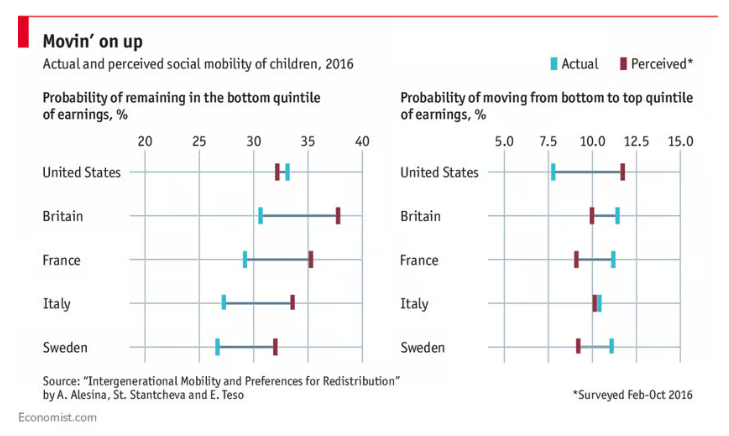
The piece in The Economist defines a relatively limited set of advanced Western countries and asks the question ”how likely is someone to move up the economic ladder?” which they define as the probability of being born in the bottom quintile of economic earnings and either remaining in that bottom quintile or, conversely, rising to the top.
Americans were more likely to remain in the bottom quintile (low 30s percent probability) than its peer nations (high 20s percent probability), and they were less likely to rise to the top quintile (~7.5% probability) than its peer nations (low teens percent probability). And perversely, expectations for social mobility in America were upside down vs Western Europe relative to their respective realities.
The OECD asks the same question from another angle: how much does a father’s economic position correlate with his children’s economic outcomes?
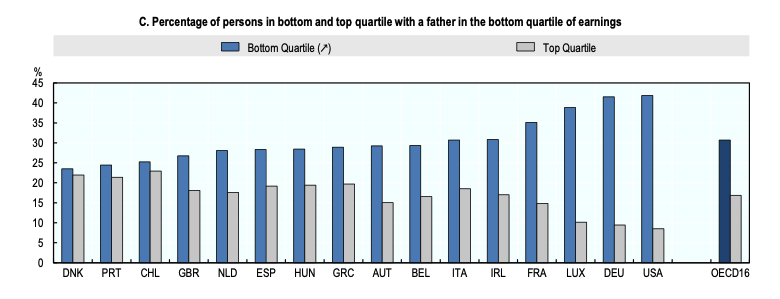
In a healthy and economically mobile society, children born to poor families would have a meaningful chance of becoming rich and they would not be overwhelmingly likely to remain poor; the more similarly likely those children are to be either rich or poor, the better, as this would show being born to a poor family is not predictive of being poor yourself. The USA does not do well by this measure: children of poor fathers in America are more likely to be poor themselves, and they are less likely to be rich.
Neither of these economic studies show that it is impossible to achieve the American Dream - to characterize our capacity for social mobility as a “permanent underclass” would be a gross exaggeration - but here in America we do a pretty bad job of realizing the aspirational goal that we’ve named after ourselves.
I care about this problem. A lot.
And I think what bugs me is that the very people who talk about the permanent underclass are, by my anecdotal observation, generally speaking, people who grew up middle to upper-middle class; they were raised by parents who cared a lot about them and invested a lot in their development and in their education; they are people who were given every advantage which could be afforded by their families and their communities; they are people who were educated and credentialed at prestigious academic institutions; they are either employed in or qualified for any number of jobs that many people would sacrifice a great deal for; and they enjoy an objectively incredible income, lifestyle, and social position.
And all that these people can think about - rather than be grateful for the opportunities and the advantages they’ve been given; rather than find it in themselves to feel compassion for those who actually are held down by the failings of our socioeconomic structure, e.g. those who are the closest thing to a permanent underclass that exists today - all those people of privilege who believe in a looming machine-caused permanent underclass can do is look around and think to themselves how fucked it all is and that they better extract what value they can from the system before it’s all too late.
It’s a billion dollars or bust. Clock’s ticking.
It’s all so sad.
Looking for closure
Despite whatever impression you may have developed reading to this point, I harbor no hatred nor resentment for the people who are haunted by the future and the permanent underclass.
I pity them.
It is true that, at the end of the day, I believe that fretting about a permanent underclass is simply an ugly concoction of privilege and entitlement and greed.
But when I talk to them, at the root of it all, what I detect in their voices is genuine anxiety and fear.
One twenty-something-year-old founder worked himself into what seemed like an actual panic attack explaining to me why it was critical that he fund and subsequently exit his company with the utmost haste for no reason other than that very, very soon it will all be too late.
These poor, unfortunate, ultra-privileged, super geniuses are terrified.
They look at AI and all they can see looking back at them is their own irrelevance.
They look at the future which they are themselves participating in building and, in that same moment, all they can feel is an insatiable loss aversion for everything that they love about themselves.
“AI is bigger than the internet; it’s as big as electricity” and yet all they are able to imagine is a world which is exactly the same as today except that everything which makes them special has been taken away.
They cannot reflect on how humanity and society have historically evolved alongside technology and also in symbiosis with it. They cannot imagine that the fabric of society might evolve again, this time as a result of intelligent and capable machines. They cannot see past the terror of contemplating their own possible irrelevance.
This is not their fault.
It is the social context they have grown up in and it is the lessons that their leaders have explicitly and implicitly passed down; lessons that they have in turn internalized and followed to their logical conclusion.
It’s sad.
Our leaders have failed us, and we have never been so desperately in need of a positive vision for the future.
One in which technology creates rather than takes away.
One in which our heroes speak of what could be as opposed to what they will displace.
One in which humanity blossoms rather than withers.